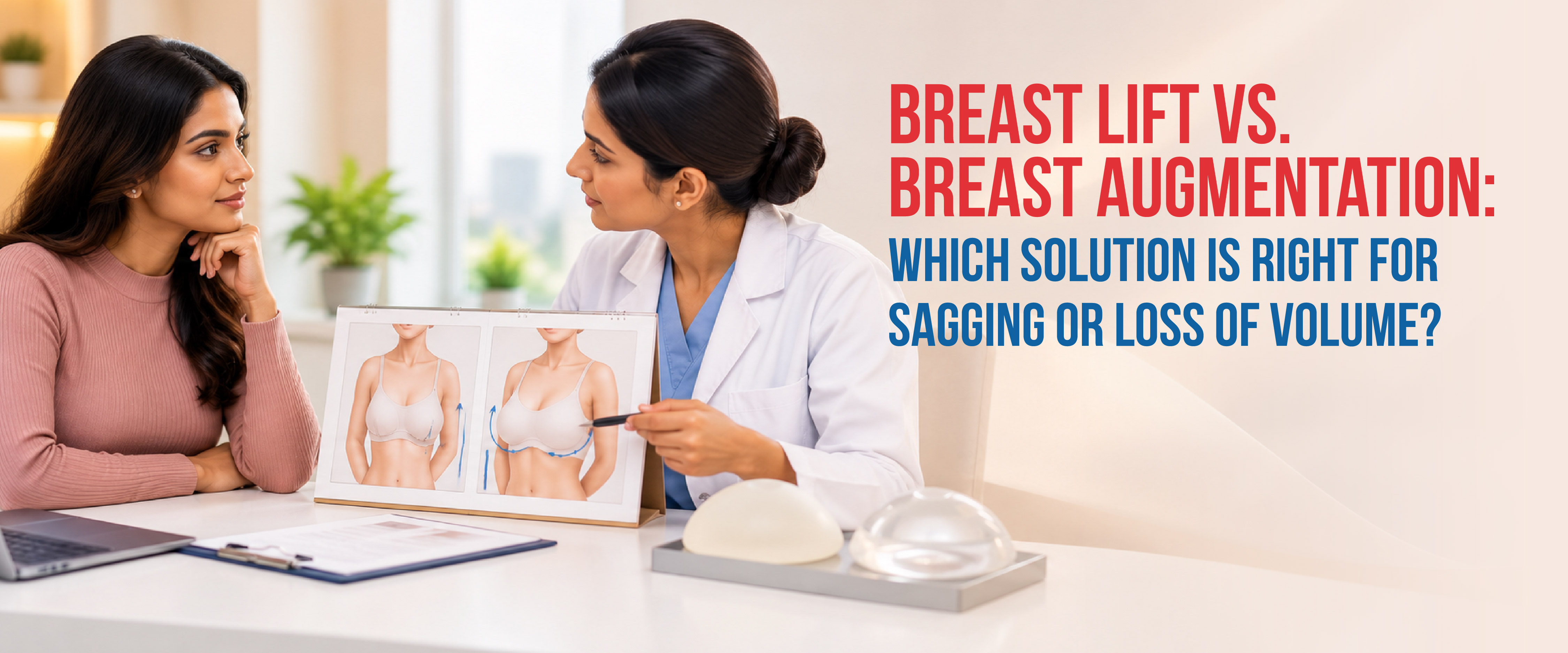
Breast Lift vs. Breast Augmentation: Which Solution Is Right for Sagging or Loss of Volume?
Age, pregnancy, breastfeeding, weight changes and the passage of time can change the shape and fullness of the breasts. For some women, the main concern is sagging; for others, it is a loss of volume. Some may experience both changes, along with a change in breast shape or position.
If you are unhappy with the appearance of your breasts and are considering a surgical solution, understanding the difference between a breast lift and breast augmentation is important. Although both procedures can improve breast appearance and proportions, they address different concerns.
Breast Lift vs. Breast Augmentation: What Is the Difference?
The two commonly considered procedures are:
-
Breast lift:
Medically known as mastopexy, a breast lift raises and reshapes the breasts by removing excess skin and tightening the surrounding breast tissue. It can also reposition the nipple-areola complex higher on the breast when required. Its main purpose is to address sagging and improve breast shape and position.
-
Breast augmentation
Breast augmentation increases breast volume and fullness, usually with saline or silicone gel implants. In selected patients, fat transfer may also be considered for breast augmentation.
Some women have adequate breast volume but feel that their breasts have become droopy or lost their shape. Others have relatively good breast position but feel they have insufficient fullness. The appropriate procedure depends on the individual’s breast anatomy, skin quality, amount of sagging, existing volume and desired outcome.
In simple terms, a breast lift primarily changes the position and shape of the breasts, while breast augmentation primarily adds volume.
Breast Lift vs. Breast Augmentation: A Quick Comparison
| Factor | Breast Lift (Mastopexy) | Breast Augmentation |
|---|---|---|
| Main purpose | Raises and reshapes breasts affected by sagging | Increases breast volume and fullness |
| Addresses loose skin? | Yes; excess skin can be removed | No, although adding volume may improve the appearance of mild looseness |
| Changes breast position? | Yes; the breast and nipple can be repositioned | Primarily adds volume; it does not reliably correct significant drooping |
| Changes breast size? | Usually little change in size; the breasts may appear smaller after excess skin is removed | Yes; size increases according to the selected implant or augmentation method |
| Implants required? | No | Usually, although fat transfer is another option for selected patients |
| Scarring | Depends on the amount of lifting required and the surgical technique; scars may be around the areola, vertically down the breast and sometimes along the breast crease | Incision location and resulting scar depend on the implant, anatomy and surgical approach |
| Best suited for | Breasts that have sagged or lost their position, particularly when there is excess skin | Breasts that lack desired volume or fullness without significant sagging |
| Can they be combined? | Yes | Yes; a lift with augmentation may be recommended when both sagging and volume loss are present |
| How long do results last? | Long-lasting, but ageing, gravity, pregnancy and weight changes can alter the breasts over time | Long-lasting, but implants are not lifetime devices and may require additional surgery in the future |
When Is a Breast Lift Usually Considered?
A breast lift may be considered when the primary concern is sagging rather than insufficient breast volume.
Common reasons women consider breast lift surgery include:
- Changes following pregnancy and breastfeeding that leave the breasts stretched or drooping
- Significant weight loss resulting in loose skin
- Natural ageing and the effects of gravity
- Breasts that have changed position or shape over time
- Nipples that point downward or sit lower on the breast
- Asymmetry in which one breast sits lower than the other
- A desire to improve breast shape without significantly increasing breast size
A breast lift removes excess skin and reshapes the existing breast tissue. It does not, by itself, add substantial breast volume. In fact, because excess skin is removed and the breast is reshaped, the breasts may appear slightly smaller or less full after surgery.
When Is Breast Augmentation Considered?
Breast augmentation may be considered when loss of volume or naturally small breast size is the primary concern.
Common reasons include:
- Feeling that the breasts are small in relation to the rest of the body
- Loss of breast volume following pregnancy, breastfeeding, weight loss or ageing
- A desire for greater fullness
- Breast asymmetry, where additional volume may help improve balance
- A desire to increase breast size while maintaining an appropriate proportion with the body
Breast augmentation can be performed using implants or, in selected patients, through fat transfer. Fat-transfer augmentation uses liposuction to remove fat from another part of the body and transfer it to the breasts. Not all of the transferred fat necessarily survives, and some patients may require additional procedures to achieve or maintain the desired result.
What If You Have Both Sagging and Loss of Volume?
This is where the distinction between the two procedures becomes particularly important.
Pregnancy, breastfeeding and significant weight loss can result in both loss of breast volume and stretching of the skin. If the breasts have lost fullness and also sag significantly, augmentation alone may not provide the desired result.
In such cases, a breast lift combined with augmentation may be considered. The lift addresses excess skin and breast position, while the augmentation restores or increases volume.
The combination is not automatically better for everyone. The surgeon has to consider skin quality, breast tissue, degree of sagging, nipple position, desired size and the patient’s overall health before recommending it.
Can Breast Implants Lift Sagging Breasts?
Breast implants can restore volume and may improve the appearance of very mild sagging, particularly when loss of upper-breast fullness is the main concern. However, implants cannot reliably remove significant excess skin or reposition a substantially low nipple.
Choosing a larger implant simply to fill stretched skin is also not a dependable substitute for a breast lift. The additional weight of a larger implant can place further stress on breast tissues.
If significant sagging is present, a breast lift may be needed, either alone or in combination with augmentation.
What About Future Pregnancy?
Pregnancy can change the breasts regardless of whether a woman has undergone a breast lift, augmentation or both. Breast enlargement during pregnancy, breastfeeding and subsequent changes in weight can stretch the skin and alter breast shape.
If you are planning a pregnancy, discuss this with your plastic surgeon before deciding on surgery. A future pregnancy may affect the appearance and longevity of the surgical result.
Breast implants do not necessarily prevent breastfeeding, but some women may experience difficulties depending on the surgery and individual circumstances. This should be discussed with the surgeon before the procedure.
Are Breast Implants Permanent?
This is an important point when considering breast augmentation.
Breast implants are not lifetime devices. The length of time an implant lasts varies from person to person, and the longer an implant remains in place, the greater the possibility of complications or the need for additional surgery. Possible complications include rupture, capsular contracture, changes in breast or nipple sensation, infection, asymmetry and implant displacement.
This does not mean that every woman with breast implants will require replacement at a particular time. There is no fixed expiry date that applies to every implant. However, women considering augmentation should understand from the outset that further surgery may be required during their lifetime.
Which Procedure Is Right for You?
A simple way to understand the difference is:
- Mainly sagging with adequate breast volume: A breast lift may be appropriate.
- Mainly loss of volume with little or no significant sagging: Breast augmentation may be considered.
- Both significant sagging and loss of volume: A combination of breast lift and augmentation may be recommended.
- Asymmetry: Either procedure, or a combination, may be considered depending on the cause and degree of asymmetry.
The final decision should be based on an examination by a qualified plastic surgeon. Your surgeon will assess breast size and shape, skin quality, nipple position, the degree of sagging, existing breast tissue and your expectations before recommending an appropriate procedure.
If you are considering breast augmentation or a breast lift in Hyderabad, STAR Hospitals is one of the best options. Women considering a breast lift or breast augmentation can consult the plastic surgery team for an individual assessment and guidance on the procedure best suited to their breast shape, concerns and desired outcome. Book an appointment today.