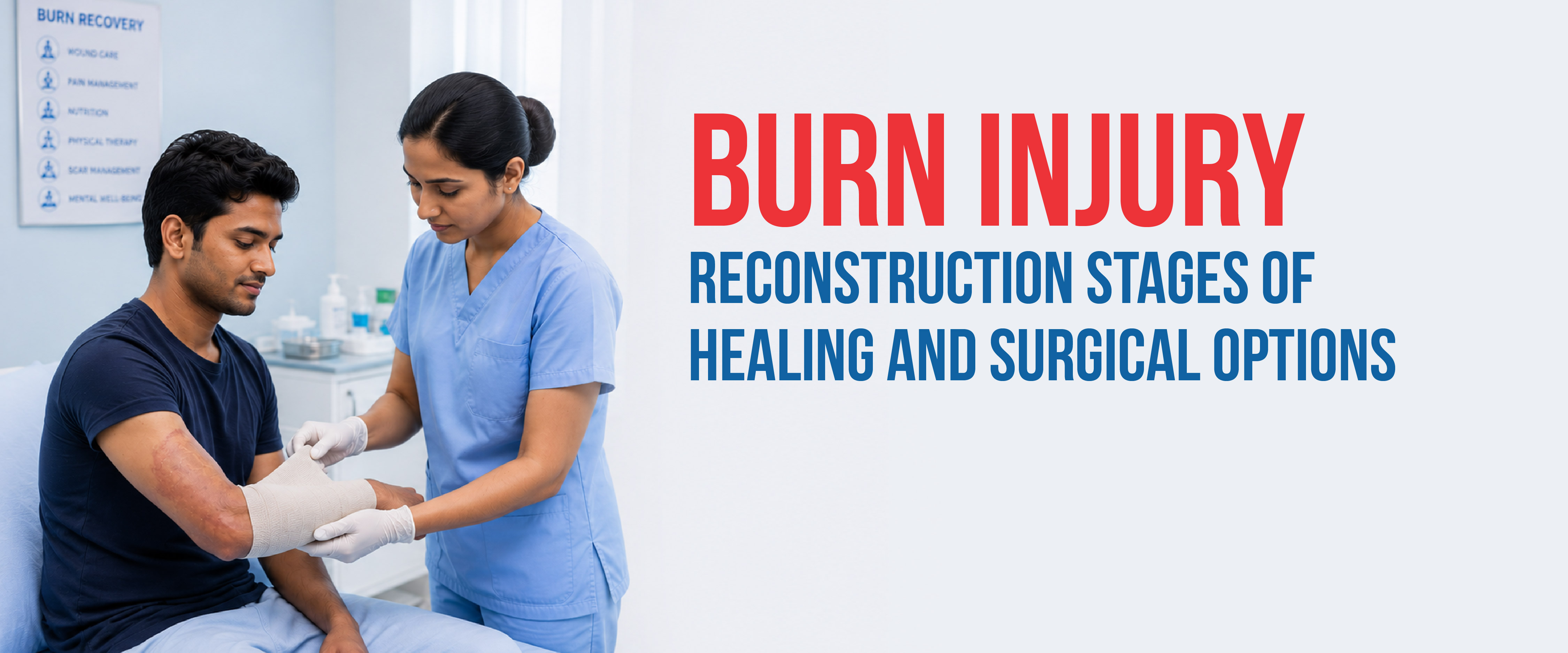
Burn Injury Reconstruction: Stages of Healing and Surgical Options
Table of Contents
- Understanding Burn Injuries
- The Chronological Stages of Burn Recovery
- Why Functional Reconstruction is Critical
- Advanced Surgical Modalities in Burn Reconstruction
- The Crucial Role of Psychological and Long-Term Care
- Dedicated Reconstructive Care at STAR Hospitals
Surviving a burn injury is a profound physical and psychological journey. When a burn is severe, the damage extends far beneath the skin’s surface, disrupting muscles, nerves, blood vessels, joints, and occasionally internal organs. Consequently, recovery demands much more than initial emergency intervention. True healing relies on a comprehensive, long-term strategy that encompasses specialised wound care, intensive physical rehabilitation, and complex reconstructive surgery to restore both basic physical function and appearance. Modern medical science, with its multidisciplinary approach and modern technological development, is now equipped to deal with burn injuries better than ever.
Understanding Burn Injuries
Burns originate from various sources such as thermal heat, open flames, scalding liquids, corrosive chemicals, electricity, or radiation. Medical professionals categorize these injuries by how deeply the tissue damage penetrates:
- First-Degree: Damage is confined strictly to the outer skin layer (epidermis). These typically resolve naturally without leaving scars.
- Second-Degree: The injury reaches into the deeper dermal layers, routinely causing intense pain and blistering.
- Third-Degree: These represent full-thickness destruction, wiping out the entire skin structure and potentially damaging the underlying subcutaneous tissues.
- Fourth-Degree: The most severe classification, where the injury destroys skin and extends directly into underlying muscles, tendons, or bone, necessitating highly complex structural reconstruction.
A patient’s overall prognosis is shaped by many variables: the depth of the burn, the total percentage of body surface area affected, the specific anatomical regions involved, the patient’s age, and any pre-existing medical conditions.
The Chronological Stages of Burn Recovery
The path to recovery is through distinct medical phases, each presenting unique clinical priorities.
- Emergency Stabilization and Treatment
Immediately following a major burn, clinical teams focus entirely on stabilization. The immediate focuses are:
- Securing and supporting respiratory tract mechanics and circulation.
- Aggressively managing fluid resuscitation to replace lost intravascular volume.
- Controlling acute pain.
- Removing dead and compromised tissue.
- Implementing strict protocols to ward off infection.
Because compromised skin can no longer shield the body or regulate moisture, severe burn patients require rigorous monitoring within an intensive care environment to prevent rapid dehydration and sepsis.
- The Active Wound Healing Phase
Once stability is secured, the focus shifts to closing the wounds. While superficial injuries can heal on their own, deeper wounds require surgical intervention. Throughout this phase, clinicians meticulously track:
- The rate and quality of cellular tissue repair.
- Fluid balances and specialized nutritional requirements are necessary for metabolic healing.
- Early indicators of localized or systemic infection.
- Joint mobility.
Targeted physical therapy often starts during this phase to actively counteract joint stiffening and preserve baseline ranges of motion.
- Scar Evolution and Active Rehabilitation
As the body repairs itself, structural scar tissue takes shape. For many survivors, this process can trigger the development of hypertrophic (thick and raised) scars or restrictive contractures. These present a serious challenge because they tighten the skin and severely limit joint mobility, especially around highly active areas like the neck, hands, elbows, shoulders, and knees.
To manage this, doctors use:
- Custom-fitted compression garments.
- Targeted scar tissue massage techniques.
- Anatomical splinting.
- Focused physiotherapy and occupational therapy.
When these non-invasive measures reach their limit, reconstructive surgery becomes the definitive pathway forward.
Why Functional Reconstruction is Critical
It is a misconception to view burn reconstruction through a purely cosmetic lens. While appearance is important, the foundational goal of these procedures is to restore everyday utility, fluid movement, physical comfort, and personal autonomy. Severe, unyielding scar tissues disturb:
- Normal joint articulation and hand dexterity.
- Facial expressions and complete eyelid closure.
- The ability to eat, speak, or breathe without restriction.
- The execution of basic daily activities.
Pediatric cases introduce an extra layer of complexity. Because scar tissue lacks the elasticity to grow alongside a developing child, younger patients frequently require a planned sequence of surgeries timed to their skeletal growth. Ultimately, addressing these structural limitations early on accelerates both physical and psychological recovery.
Advanced Surgical Modalities in Burn Reconstruction
Surgeons tailor the reconstructive approach based on the location of the scar, the quality of the surrounding donor skin, the total surface area involved, and the specific functional deficits present.
Skin Grafting Techniques:
Grafting remains a cornerstone of post-burn surgical care. This process involves harvesting healthy skin from an uninjured donor site on the patient’s body and transplanting it to the wound bed after all compromised tissue has been cleared. By sealing open wounds, grafting accelerates baseline healing, drives down infection risk, and preserves underlying mobility.
Complex Flap Reconstruction:
When a burn penetrates deeply enough to destroy underlying muscle, fat, or major blood vessels, simple grafting is insufficient. In these scenarios, surgeons utilize flap architecture. This advanced technique involves relocating a composite block of tissue (which may include skin, fat, muscle, and its accompanying vascular supply) from a healthy donor site to the injury site.
Flaps deliver distinct clinical benefits:
- Robust, high-quality coverage for exposed deep structures like bone or tendon.
- Superior long-term structural durability.
- Enhanced blood perfusion to accelerate localized healing.
Surgical Contracture Release:
When dense scar tissue locks a joint or anatomical region in place, contracture release surgery is required. The surgeon precisely incises or excises the restrictive bands of scar tissue to release the tension and restore underlying mobility. Once the structural tension is relieved, the newly opened tissue defect is resurfaced using skin grafts, local tissue rearrangements (such as Z-plasty), or localized flap transfers. This intervention is critical for maintaining function in the neck, eyelids, hands, and major joints.
Specialised Facial Reconstruction:
Reconstructing the human face requires exceptional precision because facial features dictate identity, nonverbal communication, and vital functions like sight, speech, and breathing. Facial reconstructive pathways often combine multiple techniques and multi-stage operations:
- Targeted eyelid and lip reconstruction to restore proper closure and symmetry.
- Structural remodelling of the nose and ears.
- Advanced tissue expansion (where a silicone balloon is gradually inflated beneath healthy skin over several weeks to grow new skin for neighboring burn defects).
- Refined scar revision procedures.
Laser Therapy and Structural Scar Revision:
Recent innovations in laser technology have significantly expanded non-invasive and minimally invasive options for scar management. Fractional laser treatments can structurally alter old scar tissue, effectively reducing:
- Persistent redness and hyperpigmentation.
- Overall scar thickness and density.
- Skin tightness, localized itching, and physical discomfort.
When combined with traditional surgical scar revision, these therapies help maximize the elasticity and final appearance of healed tissue.
The Crucial Role of Psychological and Long-Term Care
The impact of a burn injury is not limited to physical scars. Surviving prolonged hospital stays, coping with altered physical features, and managing chronic pain can test a patient’s mental health and self-esteem. Because of this, comprehensive recovery requires dedicated psychological counseling, peer support networks, and active family integration.
True long-term recovery relies on a sustained framework of:
- Consistent physical and occupational therapy.
- Specialised nutritional adjustments to fuel tissue regeneration.
- Proactive, daily scar management.
- Scheduled follow-up evaluations to intercept complications like late-stage
contractures or skin breakdown before they escalate.
Dedicated Reconstructive Care at STAR Hospitals
STAR Hospitals Hyderabad provides a dedicated clinical environment for comprehensive burn care through its specialized Departments of Plastic, Reconstructive, and Aesthetic Surgery. Operating across its main facilities, the hospital’s surgical teams manage the entire continuum of care, running from initial acute stabilization to advanced secondary reconstructions, skin grafting, microvascular flap surgeries, and targeted scar revision.
Backed by specialised intensive care units, advanced surgical infrastructure, and an integrated physical rehabilitation network, STAR Hospitals stands as one of the specialized regional centers fully equipped to manage complex, large-surface-area burn injuries requiring multi-stage multidisciplinary intervention. Book an appointment today to learn more.